I asked Claude AI to write an abstract of my paper, “The American Revolution of Language,” which I delivered at the Omohundro Institute of Early American History and Culture Annual Meeting, June 2026. I think Claude did an OK job.

This paper argues that four keywords central to the founding of the United States—slavery, freedom, race, and equality—did not begin with fixed, modern meanings. Instead, in the early modern period they were fluid and often overlapping terms whose senses depended on context. Over the course of the eighteenth century, as America moved from an “aristocratic” to a “democratic” language, these words narrowed, hardened, and became mutually defining, eventually forming a tightly bound “semantic field”—similar to how “man/woman” and “husband/wife” define each other. By the era of the Revolution and early republic, slavery had narrowed to mean Black chattel bondage, race had acquired its modern sense of biological human categories (largely through Jefferson), and freedom and equality had become linked as near-synonyms opposed to slavery and race. The result was a stable, emotionally powerful linguistic structure that still shapes American thought about liberty and inequality today.

Posted in Uncategorized | Leave a comment

An Excerpt of My Review in the William and Mary Quarterly (April, 2026) of Steven Sarson’s The Course of Human Events, The Declaration of Independence and the Historical Origins of the United States

During Joe Biden’s short campaign for reelection to the U.S. presidency in 2024, he frequently said that “America is an idea.” His inability to communicate the meaning and significance of that idea is perhaps one of the reasons that his campaign was unsuccessful. He cannot, however, be completely blamed for this, since many contemporary historians have also found it difficult to explain the idea of America, even in its original expression in the Declaration of Independence. Instead, when scholars discuss the declaration, they often minimize the importance of its abstract ideas and focus on its political importance as an announcement of American independence from Great Britain.1 When they do focus on those abstractions, many historians and political philosophers criticize the founders for their failures to act on them.2

Steven Sarson’s new book, The Course of Human Events, is an example of this phase in the scholarship. He agrees with much recent writing on the declaration that says its primary purpose was to announce the United States’ independence. He argues that the most significant words in the declaration are “when in the course of human events” in the first paragraph rather than the now more famous phrase “all men are created equal” in the second paragraph, and justifies that claim by arguing that the declaration did not represent a radical break with the past, as is often popularly imagined.3 The “first paragraph not only takes the reader from the beginning of time to the present but also looks to the future” (15), he writes. He stresses the continuity of thinking during the tensions with Great Britain, suggesting that the declaration did not represent a novus ordo seclorum. He supports his reading of the document with an extensive history of the arguments of eighteenth-century philosophers, the founding fathers, and legal scholars and historians. His in-depth discussion of the arguments of Thomas Jefferson, John Adams, Abigail Adams, John Dickinson, Richard Bland, and other founders will be valuable to many readers for the ways it illuminates the background of the declaration.

Sarson agrees with the fundamental ideas of equality and liberty in the declaration, but he is harshly critical of what he calls the “creedal” (6) interpretation that imagines the document as the product of a fixed moment in time. The “self-evident truths” of this interpretation, he argues, have “been both a means of perpetuating historical iniquities and an argument for abolishing them” (12). He dedicates his book to showing that the original meanings of the declaration have little to justify them, reminding us that the ideas in the document rationalized and justified the exclusion of Black people, Native Americans, women, and propertyless white men, and “continues to shape the American present . . . to the detriment of many American citizens today” (211). He is not, however, always clear on the distinction between the creedal interpretation and the declaration’s fundamental ideas; which is the baby and which is the bathwater?

In concert with most recent scholars, Sarson holds that John Locke’s “Second Treatise of Government” was an important influence on Jefferson and the founding generation. It was widely read and cited in the years before the revolution, and its ideas and even key phrases are nearly identical to those in the declaration.4 According to Sarson’s reading, Locke (and subsequently Jefferson and most of the founders) imagined that people in a state of nature enjoyed freedom and equality collectively and not as individuals, and they ceased to enjoy them when people left a state of nature and entered civil society. Neither Locke nor Jefferson, therefore, endorsed  an idea of universal individual rights. The alleged equality espoused in the declaration, Sarson says, only meant equality for white men of property. Furthermore, Locke’s idea that America was a tabula rasa and that Native Americans lived in a state of nature justified the colonists’ right to take their land and put it into productive use.5 The land belonged to the colonists who acquired it by “blood and treasure” (46)—that is, through violence and purchase.

Over the course of Sarson’s extensive discussion, he makes a number of curious statements that may raise eyebrows. . . .

Posted in Uncategorized | Tagged , , , | Leave a comment

A review of my book, Democracy and Empire

CJ-Online, 2023.01.02

BOOK REVIEW Classical Journal Online

Democracy and Empire: The Athenian Invasion of Sicily, 415413 BCE. By ALEXANDER 0. BOULTON. Lanham, MD: Hamilton Books, 2021. Pp. xiv+ 176. Hard­ back, $34.99. ISBN: 978-0-7618-7297-9.

They say, “Don’t judge a book by its cover,”‘ but Alexander Boulton’s Democracy and Empire is tricky to judge by its title. The main title may suggest a scholarly monograph about the tension between Athens’ democracy and its imperial reach, but the subtitle-The Athenian Invasion of

Sicily, 41S-413 BCE-is a better reflection of the book’s actual content. Boulton’s book largely re-presents the events of Thucydides’ History of the Peloponnesian War with a particular focus on the Athenian campaign in Sicily. In contrast to Thucydides’ relatively complex and disparate history, Boulton simplifies and focuses this narrative, making it more comprehensible.

Democracy and Empire is a historical narrative meant to make Thucydides’ story easier. Boulton states his objective: “this book simplifies Thucydides’ monumental history by describing a single, narrowly-focused event in Thucydides’ history-the invasion of Sicily”‘ ( 3 ). Boulton’s goal in making Thucydides more digestible is to encourage readers who otherwise would find the Greek historian too daunting (4). Given this purpose and ambition, Boulton’s book will be a useful companion piece for students reading (and possibly struggling with) the History of the Peloponnesian War. Boulton’s book will be a great resource assigned to high schoolers, undergraduates or grad students studying the classics. By focus­ing his story specifically around the Sicily campaign, while still providing solid background on Greek cultures and contexts, Boulton provides an accessible anchor for accessing Thucydides.

Boulton’s style and approach reflect the address to student/ amateur audiences. His prose is relatively simple and direct, making the book a quick and easy read. He also provides a lot of useful background information that make the Greek world and the events of the Sicily campaign comprehensible for readers. For instance, he provides a brief history of Sparta prior to the Peloponnesian war (8-11) and a longer history of Athens and the development of democracy (11-27). The book also provides cultural and historical backgrounds, like the discussion of hoplites and Greek martial culture (95-99), which helps explain the Athenians’ dedication and willingness to continue fighting despite the increasingly hopeless situation in Sicily. These explanatory portions diverge from Thucydi­des, making an excellent supplement by illuminating things that modern readers may not understand but that the Greek historian would have seen as common knowledge.

One technique Boulton often relies on is analogies a United States-based student would likely understand. This is most prevalent at the opening of Chapter l, which includes an extended analogy between the American Revolution and the Persian Wars as origin points for US and Hellenic culture, respectively. Boulton explains, “In both cases, small, culturally backward states on the periphery of a great empire revolted, and during the ensuing war, they united and shaped their own unique identity as a united, independent, and freedom-loving people. The major personalities and battles became embedded in their national folklore” (5). While Boulton does remind readers of the significant differences between Hellas and the US, he also writes, “By looking closely into the cloudy mirror of ancient Greece, however, we may see ourselves a little more clearly. We might gain some insight into our own history, and even perhaps take a small uncertain peek into our own future” (6). The collective pronouns we and our clearly situate Boulton as speaking to a US readership. Indeed, the reliance on historical analogies with the United States may not be helpful to readers from other nations. Additionally, while Boulton here suggests that an understanding of the Peloponnesian War might illuminate the contemporary US political situation-a promising enough premise-the book never returns to this point in much depth. Instead, Boulton leaves this tantalizing idea for readers to make of it whatever they will.

This is symptomatic of another limitation of Boulton’s work: potential unfulfilled. In particular, one of the biggest disappointments is the failure to genuinely work through the tensions between Athenian democracy and the imperial ambi­tions reflected by the doomed campaign to Sicily-a topic promised both by the title and in the Introduction (2). Boulton’s approach to this question is largely the same as his primary source, Thucydides. The link between democracy and empire is developed by narrating decisions made by the Athenian government. But, like Thucydides, Boulton generally lets these narratives stand on their own as though the historical lesson is self-evident, rather than actually interpreting Athens’ actions to make an argument about the link between the two titular topics. Again, if one is looking for a scholarly monograph developing a sophisticated argument, this is not the book to turn to.

Other issues with Democracy and Empire are structural and stylistic. Although the book is ostensibly focused on the Sicily expedition, the actual discussion of the invasion doesn’t start until Chapter 3: The Sicily Campaign, beginning on page 69 (out of 150 pages, excluding the Bibliography and Index). The chapter then provides further background until finally getting to the beginning of the invasion on page 78. While much of the background described in the first two chapters generally follows Thucydides’ History of the Peloponnesian Wm that his­ tory could be condensed to refocus the book more genuinely on the Sicily disaster. For a book with the stated purpose of describing this campaign, much page space is given to history not directly connected to the invasion. In stylistic terms, there are repeated grammar and mechanics errors throughout the text. While these do not seriously undermine the quality of the work, they are a regular irritation. A thorough copyediting wouldn’t have gone amiss.

Despite its drawbacks and limitations, Alexander Boulton’s Democracy and Em­pire will be a useful resource for students struggling with Thucydides’ History, or otherwise seeking an accessible introduction to the Peloponnesian War. The straightforward historical narrative-supplemented with maps, illustrations and discussions of Greek culture-makes the book accessible and engaging. More advanced scholars, classicists and historians may not find much that’s new or revelatory in Democracy and Empire, but it is worthy reading to potentially assign in classes.

PHILLIP ZAPKIN

Pennsylvania State University

Posted in Uncategorized | Tagged , , , , | Leave a comment

My “blurb” for the Panorama a blog of the Society for the History of the Early Republic, March 2024

THE LANGUAGE OF RACE IN EARLY AMERICA

Alexander Boulton

In 1782, Hector St. John de Crèvecœur in his book, Letters from an American Farmer, famously asked, “What, then is the American, this new man?” He answered his question by saying that the American is “a mixture of English, Scotch, Irish, French, Dutch, Germans, and Swedes. From this promiscuous breed, that race now called Americans have arisen. . . . Here individuals of all nations are melted into a new race of men.”[1] Today, we are struck by the omission of Africans from Crèvecœur’s list of those who made up “this promiscuous breed,” since they comprised one of every five individuals in North America at the time he wrote. This we know, however, is part of a long history of the erasures of Blacks in American history. The modern reader might find it more interesting that Crèvecœur describes Americans as a “race.” Crevecoeur’s choice of vocabulary reminds us that many words in the eighteenth century, especially abstract nouns, had a wide variety of meanings. The word race was one of many abstract terms that only gained their modern meanings in the late eighteenth and early nineteenth centuries. Through most of the eighteenth century, the word race could refer to almost any group of people. It was common, for example, to refer to the “race of kings,” or the “race of heroes,” or the “Irish race.”

The Tower of Babel by Pieter Bruegel the Elder, 1563. The Biblical story of the Tower of Babel is probably the earliest illustration of human beings’ awareness of the arbitrary relationship between words and reality.
Originally, a divine language represented the world through words that had a direct relationship to the real world. We lost this one-to-one relationship between words and reality when humans divided themselves into nations with different languages. Courtesy of Wikimedia Commons.

In the middle of the eighteenth century, natural philosophers like Carl Linnaeus and the Comte de Buffon began to formulate a more restrictive meaning for the word race, but they commonly used the word interchangeably with varietycategory, and nation. It was only in the last years of that century that the word race gained its dominant position with its meaning as a division of human beings based on physical (and through much of that period, intellectual and moral) criteria.[2]

This evolution of the word race was part of a much larger transformation in language during the Revolutionary era, which I discuss in my recent JER article, “The Declaration of Independence and the Language of Slavery.” We can see this transformation at work in words like prideambition, and enthusiasm, which also underwent significant changes in meaning. Each of these words had primarily negative associations in the texts of writers in the mid-eighteenth century. To them, these words were associated with the uncontrollable and dangerous passions of the “lower orders.” The gradual shift to the more positive associations of these words, later in the century, was essential to the creation of a democratic language and a democratic system of government.

Benedict Anderson, in his book Imagined Communities, described this process as the creation of “national print languages.”[3] These new languages, propelled by the rise of new print technologies and the rise of popular literacy, brought together large numbers of people from different geographical areas and different cultures and backgrounds, giving them a sense of a common identity with one another and with the emerging nation–states of the early nineteenth century.

Thomas Jefferson agreed with Anderson that the evolution of language was a necessary condition for the creation of a nation. He argued that in America, a “great growing a population, spread over such an extent of country, with such a variety of climates, of production, of arts, must enlarge their language, to make it answer its purpose of expressing all ideas, the new as well as the old. The new circumstances under which we are placed call for new words, new phrases, and for the transfer of old words to new objects.”[4]  Jefferson claimed that he was a friend of “neology”—the creation of new words. In this, he opposed the “purists” of language, such as Jonathan Swift, James Burnett, Lord Monbodo, and Robert Lowth, who strived to make language conform to classical models. In this, Jefferson aligned himself with “linguistic radicals” in England, such as Horne Tooke and Joseph Priestly, who advocated the use of common speech as a model for language. Ultimately a synthesis of these two forms of English would come to shape the popular language through most of the modern era.

Lewis Carrol’s imaginary world was constructed out of his understanding of the polysemous nature of words. He further illustrated this idea in his poem, “The Jabberwocky.” Humpty Dumpty from Through the Looking Glass, by John Tenniel, 1871. Courtesy of Wikimedia Commons.

This whole process was brilliantly explored by Alexis de Tocqueville in the chapter of his book Democracy in America titled “How American Democracy has Changed the English Language.” Tocqueville described “the changes that the idiom of an aristocratic people may undergo when it becomes the language of democracy.” Americans, he wrote, “introduced many new words” and “old English words were often given new meanings.” Tocqueville claimed, however, that “the genius of democratic peoples is revealed not only by the large number of new words they introduce but also by the nature of the ideas those new words represent.”[5] Tocqueville was not pleased, however, with the way that Americans frequently resorted to abstractions. Tocqueville claimed that “Democratic peoples have a taste and often a passion for general ideas. . . . This love of generic ideas manifests itself in democratic language through the constant use of generic terms and abstract words.” The problem with this, he said, was that “an abstract word is like a box with a false bottom: you can put in any ideas you please and take them out again without anyone being the wiser.”[6]

One of the ideas that inspired my JER article is that putting in or taking out a single word can affect the meanings of other related words. Linguists call these webs of interconnected meanings “semantic fields.”[7] The word race along with words like freedomslavery, and equality formed such a semantic field, and this semantic field became embedded in the language that dominated in America throughout the nineteenth and most of twentieth centuries.

Today, as electronic media replaces print media, we are again experiencing dramatic changes in our language. I should say languages—plural. Daily, we are seeing the creation of new words and old words gaining new meanings. Often these are tied to new ideas about race and gender (wokequeerbougieKarensnowflakethey). But it’s not just the meanings of individual words that are shaping and reflecting a fragmentation of American society. It is the whole context of the words we use and how we use them that is increasingly dividing Americans into different realms of language, perception, and understanding.


Endnotes

[1] Hector St. John de Crèvecœur, Letters from an American Farmer (New York, 1981), 68–70.

[2] Nicholas Hudson, “From Nation to Race: The Origin of Racial Classification in Eighteenth-Century Thought,” Eighteenth-Century Studies 29 (Spring 1996), 247–64.

[3] Benedict Anderson, Imagined Communities: Reflections on the Origin and Spread of Nationalism (London, 1983), 44–46.

[4] Thomas Jefferson to John Waldo, Aug. 16, 1813, in Thomas Jefferson, Writings, ed. Merrill D. Peterson, Library of America edition (New York, 1984), 1295–96.

[5] Alexis de Tocqueville, Democracy in America, ed. Oliver Zunz, trans. Arthur Goldhammer, Library of America edition (New York 2004), 2:, 547, 548.

[6] Ibid., 552–53.

[7] John Lyons, Semantics (Cambridge UK, , 1977), 1: 250–61; Stephen Ullman, The Principles of Semantics (1951; repr. Oxford, UK, 1957), 152–70.

Posted in Uncategorized | Tagged , , | Leave a comment

Baltimore Sun papers letter to the editor, May 10, 2024

I was surprised and a little shocked by Sam Faddis’s description of what he described as an overturning of a “standard narrative” of political conflict in the United States. (Baltimore Sun, “The U.S. is Divided,” May 6, 2024.) Mr. Faddis apparently believes that the United States is in the midst of a class struggle between “the American people” and “self important . . . white liberals [who are] isolated from reality.” He apparently thinks that we have finally achieved that illusion of a “post-racial society.”

A little historical perspective may be helpful in understanding where we are today. Historically the “standard narrative” has been that the Republican party represented the interests of the wealthy and of businesses, and the Democratic party represented the working class. Republicans sought to reduce taxes, especially for themselves, and reduce regulations on businesses.

The Democratic party, meanwhile, brought us programs like Social Security and Medicare, and supported funding for education and the protection of the environment. All of these were programs that benefited the middle class and all of them were originally vehemently opposed by Republicans. The Democratic party was, admittedly, late to supporting the Civil Rights movement, but since the late 1960s, the Democratic party has been one of the strongest advocates for Black economic and political power. Again, this was in opposition to the Republican party, whose policies have hurt urban areas that are majority Black and which have diluted Black voting power.

Much has changed over the past decade, and new political alignments are forming. But much remains the same. Republicans still support lowering taxes on the wealthy and eliminating regulations on corporations. Republican policies will only lead to further disfranchisement of Blacks, a dirtier environment, and, more recently, restrictions on women’s right to control their bodies. The most fundamental changes in the Republican party recently, have not been in their essential ideology. It has been their success in gaslighting a large segment of the population through conspiracy theories and outright lies, and through the rise of a messianic cult of personality that has made many social differences appear less relevant.

Posted in Uncategorized | Tagged , , , , | Leave a comment

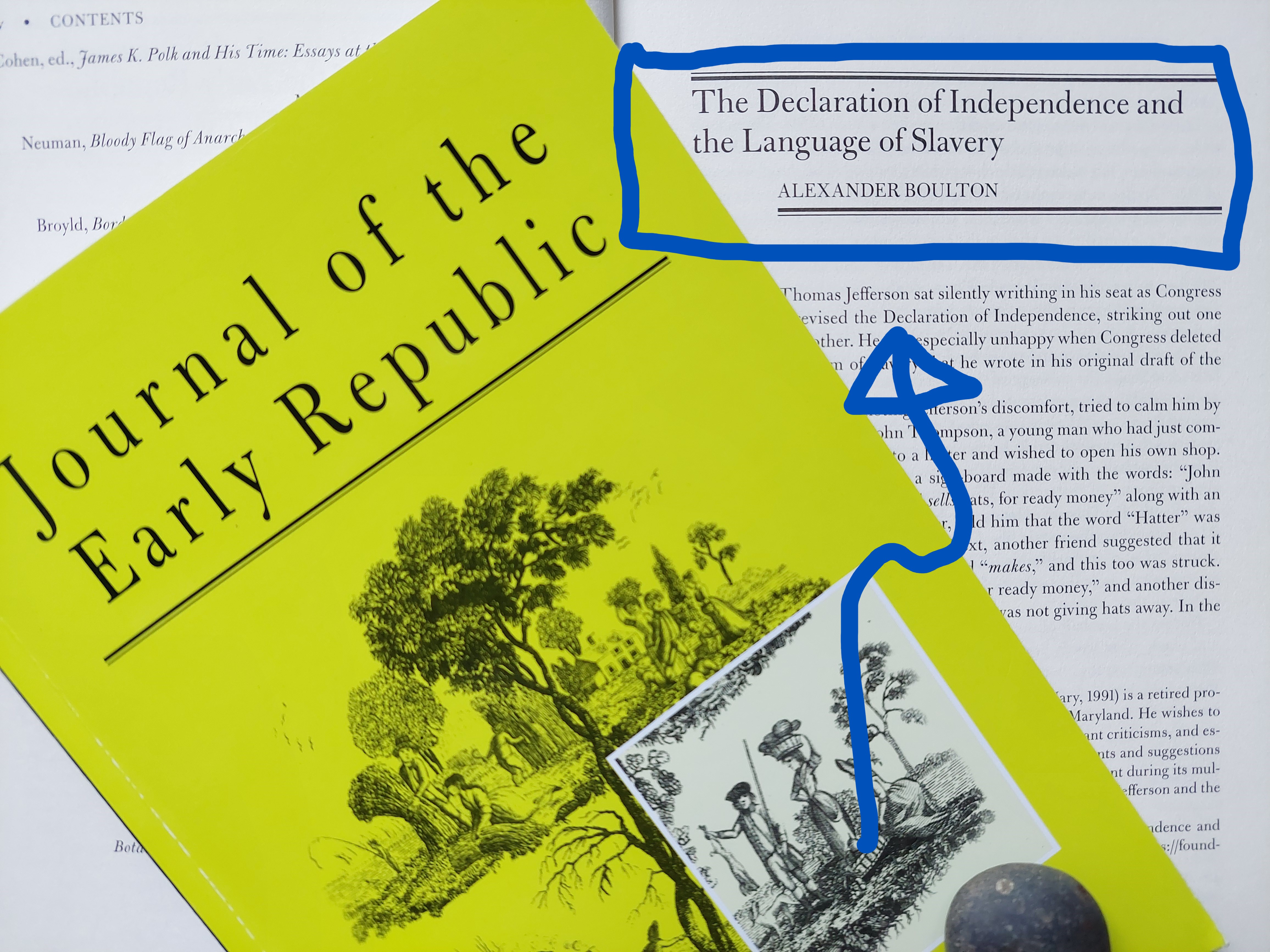
“The Declaration of Independence and the Language of Slavery” my article in the Journal of the Early Republic, Spring 2024.

Posted in Uncategorized | Leave a comment

To My Friends who are Thinking of Voting Republican

To my friends who are thinking of voting Republican,
Hey, I get it. You don’t like Joe Biden. I have some qualms about him too. You are concerned about the price of gas. You think that we need a better policy about the border. You are worried about your family and the future of the country. I share many of your concerns. But let’s take a broader view. Back when I was growing up, the Republican party was been the party of the wealthy and of big businesses, and the Democratic party was the party of the working class. The Democratic party was the party that brought you Social Security, Medicare, the Affordable Care Act – policies that helped create the middle class. All of them are policies that Republicans were against, and which many in the party still want to cripple. Much has changed over the past few years, but the fundamentals of the parties have not changed. All of the major accomplishments of the Republican party over the last century have benefited the wealthy by reducing their taxes and benefited corporations by reducing regulations: regulations that protect consumers, establish safety standards in industries, and protect the environment.
So what, you might ask, have Democrats done for you lately?
Under Biden, Congress passed the Inflation Reduction Act, the American Rescue Plan, and (with the help of Republicans) an Infrastructure bill. All of this new legislation reduces the costs of your medical insurance and prescriptions. These acts have created hundreds of thousands of jobs in industries, and in the construction of roads and bridges. These programs have led to higher wages and have reduced childhood poverty.
I suspect that there are many things that we agree upon. We would like responsible gun laws, probably, background checks. We would like a return to the Roe v. Wade decision on abortion. We would like corporations and the wealthy to pay their fair share of taxes. If you agree with these things, maybe you should think twice about voting for a Republican.
Yes, there are still major problems confronting us. Inflation is high, mostly due to supply lines broken by the Covid epidemic and the fighting in Ukraine. There is no resolution to the crisis at the border. Homelessness is on the rise. Global warming continues. These are problems that need responsible government that is committed to giving every individual the opportunity to attain their best lives. These are problems that will not be solved by divisive rhetoric and vitriolic name-calling. As Barack Obama said, “There is more that unites than divides us.”
Peace and love,
Alex

November 4 2022

Posted in Uncategorized | Leave a comment

My Book on the Peloponnesian War has just been published.

Athens’ decision to invade Sicily in 415 BCE marked an important turning point in its war with Sparta, which led ultimately to Athens’ defeat and the collapse of its empire. This is the story of the men who persuaded the Athenians to make war against Sicily and who led the great armada against the island in middle of the Mediterranean. The Athenian and Spartan leaders in the war between Athens and Sparta take center stage in this story. But their story cannot be told apart from the political and social structures, along with the religious practices, and the roles of women, foreigners, and slaves in Athens during the great intellectual awaking of Athens in the fifth-century BCE. Underlying all of this is the story of the complex relationship between Athens’ democracy and its empire. It is a story that has important lessons for the world today.

If you would like a free copy please email me at aoboulton@hotmail.com

Democracy and Empire, The Athenian Invasion of Sicily, 415-413 BCE

Alexander O. Boulton

Introduction:

Athens was at the height of its power when it decided to invade Sicily in 415 BCE.(1) The conquest of Sicily, if it had been successful, might have made Athens the victor in its long war against its enemy, Sparta. It could have cut off Sparta’s access to the grain and timber that they imported from the great island in the center of the Mediterranean, and it could have been the first step in Athens’ domination of Carthage, Italy, and the Iberian Peninsula. Three hundred years later, the conquest of Sicily would initiate Rome’s subjugation of virtually all the lands surrounding the Mediterranean. And, 2,400 years later, the invasion of Sicily by the Allied Powers during World War II, would be the beginning of the end of the Axis powers. In those cases, the occupation of Sicily initiated two of the greatest epochs in the history of humankind with unprecedented levels of material prosperity, political stability, peace, and artistic and intellectual creativity.

This could have been Athens’ destiny. The result of the Athenian campaign, however, was one of the most catastrophic defeats in military history. It was the tipping point in Athens’ war against Sparta, which led ultimately to Sparta’s victory and the end of the Athenian Empire. This was one of the great turning points in history, whose long-lasting consequences continue to shape who we are and how we think nearly two and a half millennia later.

The story of this tragic event was first told by the Greek historian Thucydides, who was one of Athens’s foremost generals in the war. Unfortunately for Thucydides, he failed to prevent Spartan forces from taking an important Athenian outpost in the war, and the Athenian Assembly punished him for this failure by removing him from command and exiling him from Athens. Fortunately for us, this gave Thucydides time to write his great history of the Peloponnesian War (431–404 BCE), named after the large Peloponnesian peninsula at the southernmost tip of mainland Greece and the home of Sparta.

Also, fortunately for us, Thucydides spent much of his time in exile behind enemy lines with the Spartan forces. From this unique perspective on the war, Thucydides crafted one of the first, and one of the greatest, historical narratives ever written. His history of the war is the principal source for this retelling of the story of the Sicilian campaign.

My original intention in writing this book was solely to describe the Sicilian Campaign, which I believe is the most important turning point in the war between Athens and Sparta. It is also an exciting story of remarkable personalities and dramatic events. As I wrote and revised this work, however, it became clear that this story could not be told without also considering the complex relationship between the Athenian democracy and the Athenian Empire.

Thucydides gives us the first and the best description of the workings of the world’s first democracy. The Athenian ideas that common citizens can make their own laws, that citizens hold the rights of free speech and equality before the law, and that government serves the interests of all its many people without favoring the few who are rich, were all ideas unknown in the world before his time.

Moreover, for many people, including many of America’s Founders, Thucydides’ story of Athens’ failure in the Peloponnesian War and the collapse of its empire is proof of the weakness of a democratic system of government. For them, the Athenian democracy was the cause of the demise of its empire.

 Nearly 2,500 years later, we might believe that we see parallels between our situation today and the collapse of the Athenian Empire or the decline and fall of the Roman Empire 1,000 years later. But history is not solely a story of tragic declines and falls. It is also a story of growth and rejuvenation, and one might seem like the other to those who are in the midst of experiencing them.

Thucydides is a wise guide to many of these issues. He has been praised throughout the centuries for his realistic depiction of events and for his objectivity. He saw how the actions and motives of individuals often had great unforeseen consequences, and he saw how small details shaped larger historical patterns. He wrote his narrative of the war between the Athenians and the Spartans during one of the most remarkable periods in human history. Many people who lived in Thucydides’ home of Athens and its neighboring territories were beginning to see the world with eyes newly opened. A veil of superstition, of oracles, and of prophecies was slowly being lifted. During most of humankind’s history, the physical world and a supernatural realm seemed to coexist without borders. Spiritual forces swirled around, flowing in and out of the material world, and minds perceived things beyond the powers of eyes and ears. Thucydides was one of the first to exclude supernatural forces from his observation of the world in much the same way that we do today. The story of the Sicilian campaign is, thus, many stories, both dark and brilliant, and we can choose one, or we can imagine another, which is more relevant to each of us.

Admittedly, the story of the Sicilian campaign and the Peloponnesian War is not very well known. For most people who have heard of it, it is a story of a long-dead people in a far-away land in an inconsequential war. Part of the blame for this rests with Thucydides himself. As important as his history is, in many places, it is a very dry and boring catalog of places and events which have little clear significance to anyone but the most pedantic scholar. Thucydides admits early on in his book that his goal was not to appeal to everyone. He set out to write about the war as accurately as possible, “as a possession for all time,” without any romance or poetry, and purposefully not “to win the applause of the moment.” Evidence of his disregard for popular approval is seen in his writing style, which is, according to one of his admirers, “complex,” “convoluted,” “idiosyncratic,” and “obscure.” (3)

The awkward style and structure of Thucydides’ narrative is partly the result of the conditions of its composition. Thucydides began to write his history near the beginning of the war and continued to write while the war was going on. In most cases, he had no idea as he wrote which events would have a greater or lesser impact on subsequent events, which events he should highlight in his narrative, and which events he should pass over quickly. If he had more time to revise his work, perhaps, it would have been very different.

In addition to all this, Thucydides often assumes that his readers are familiar with the geography of ancient Greece. Who knows today where Amphipolis, Thrace, or Euboea are? — or the thousands of other places that Thucydides names? Often modern historians have only contributed to these problems, themselves getting lost in all the minutia of details, losing sight of the larger picture, and filling voids in Thucydides’ narrative with sometimes dubious conjectures.(4)

A close reader of Thucydides’ text, however, is likely to be rewarded for the effort. Thucydides’ history is a complex tapestry of events in which he tells many overlapping stories simultaneously. Its various threads weave in and out, in a complex and often awe-inspiring pattern. This is often confusing, but it is also part of what gives his history such power. A reader can become emotionally and intellectually engaged as the work unfolds, and as the reader sorts out the many narratives to find meanings in the myriad assortment of details. Much like real life itself.

For those of us who do not have the time to engage with all these issues, this book simplifies Thucydides’ monumental history by describing a single, narrowly-focused event in Thucydides’ history—the Athenian invasion of Sicily. This was the pivotal event in Thucydides’ history, and, as I believe, the single most decisive event in the history of ancient Greece. Critics can argue that the result is a brutal surgery of Thucydides’ text, since it leaves out many important events, and dismisses many of the themes that make his book still relevant two millennia later. These criticisms, of course, are appropriate. If this work, however, inspires readers to discover the work of Thucydides on their own, or to delve further into the history of ancient Greece, or stimulates thinking about the interrelated natures of democracy and empire, then some of the purpose of this book will have been accomplished.

Posted in Uncategorized | Leave a comment

My Youtube channel “Sandy’s History”

Posted in Uncategorized | Leave a comment

My Op-Eds in the Sun Papers

No Trump Fingerprints Doesn’t Mean No Crime,” Baltimore Sun, 3/30/2019

The old joke that absence of evidence is proof that the conspiracy is working is no longer a joke, and no longer old.

Attorney General William Barr’s summary of the Mueller report stated that it did “not establish that the President was involved” in collusion with Russia to interfere with the 2016 elections. This seems on first reading to be a fairly straightforward statement that the president was innocent of collusion. But what is this conclusion based on? The investigation into Russian collusion was impeded every step of the way by the president’s public actions, which may have prevented relevant facts from emerging.

The fact that Mr. Trump and his associates have been able to leave no fingerprints at the scene of the crime does not prove that no crime was committed, nor that he is innocent.

To many of us who have followed this story, Mr. Barr’s conclusion is incredible. Despite Mr. Barr’s statement to the contrary, there is a significant amount of circumstantial evidence that Mr. Trump and his associates worked with Russia to manipulate the 2016 presidential election. According to the Mueller report, the Russians made multiple attempts to contact the Trump campaign, and we know that at least Donald Trump Jr. was very eager to accept their aid when he responded to a request for a meeting to discuss “dirt on Hillary.” “I love it,” he replied. The result was the famous Trump Tower meeting of June 2016 in which the president’s son, Donald Trump Jr.; Trump’s son-in-law, Jared Kushner; and his campaign manager, Paul Manafort, met with four Russian operatives. President Trump subsequently advised Mr. Trump Jr., to lie about the purpose of that meeting, stating that it was about adoption policy.

We know as well that a large number of Mr. Trump’s advisers, including Mr. Manafort and Michael Flynn, his national security adviser, had numerous meetings with Russian operatives before the election, and that they lied about those meetings. Mr. Manafort is also charged with giving Republican polling data to a Russian operative. This data could have been used by the Russians in their social media campaign to influence the 2016 election.

In addition to the secret meetings that Mr. Trump’s advisers had with Russians, we should add President Trump’s own secret meetings with Russian President Vladimir Putin (five according to the New York Times), at which no American officials other than Mr. Trump were present, and in which the translator’s notes were confiscated.

So far, five associates of Mr. Trump have been convicted as a result of the Mueller investigation, while others are facing trial on charges related to the Russian investigation.

From the investigations, it is clear that the Russians wanted to work with the Trump campaign, and the Trump campaign wanted to work with the Russians, and they each had ample opportunity to do so. Eventually, we may know much more.

The case against Mr. Trump for obstruction of justice is equally compelling. The evidence for this starts with Mr. Trump asking the director of the FBI, James Comey to “let this go,” meaning the investigation of Michael Flynn. Ultimately, Mr. Flynn pleaded guilty to obstruction of justice relating to the Russian investigation. By then, however, Mr. Trump had fired Mr. Comey, publicly stating two times that he did so because of the Russian investigation. Add to this Mr. Trump’s frequent criticism of the Mueller investigation and his attempts to impede its work, most clearly by refusing to testify in person with Mr. Mueller’s investigators. And, add to this his dismissal of his attorney general, Jeff Sessions, related to Mr. Sessions’ recusal from oversight of the Russian investigation.

Finally, there is overwhelming evidence that Russia received benefits from their support of Mr. Trump in the 2016 election including: the relaxation of the Russian sanctions on some of Mr. Putin’s key associates; the weakening of a statement on Ukraine in the Republican Party campaign platform in 2016; Mr. Trump’s consistently siding with Mr. Putin, most notably his agreeing with Mr. Putin (in Helsinki) that Russia did not interfere in the 2016 election, despite the conclusions of the U.S. intelligence community. And, most importantly, Mr. Trump’s lack of support for NATO and the weakening of our ties with our traditional allies in Europe.

William Barr’s report unfortunately leaves many of the most important questions raised by the specter of Russian interference in the 2016 elections unanswered. That is why Congress and the courts must continue to aggressively investigate these issues, and why the full Mueller report must be made public.

Alexander O. Boulton (aoboulton@hotmail.com) is a professor of history at Stevenson University.


Doubling Down on Trump,” Baltimore Sun, January 16, 2019

Many people have concluded by now that it is impossible to understand the workings of the mind of President Donald Trump. Is he a masterful politician following a preconceived plan to reform government and strengthen America’s international relations? Or is he a bully and a psychopathic liar whose policies will destroy American democracy and the nation’s status in the world?

While understanding Donald Trump might be near impossible, a book written in 1956 may give us insights into the motivation and behavior of Mr. Trump’s base of enthusiastic supporters. The book is “When Prophecy Fails,” by social psychologist Leon Festinger.

In it, Festinger described how he with a group of colleagues joined a doomsday cult led by a charismatic Chicago housewife, who claimed to communicate with extraterrestrial aliens who revealed to her that the world would be destroyed in a great flood on Dec. 21, 1954. She gathered a small group of followers who believed that they would be saved at midnight of the 20th by boarding a flying saucer that would take them to the planet Clarion. Many members of the group of true believers quit their jobs and sold all their possessions in preparation for the event. On the appointed night, the group sat in a circle, waiting for the flying saucer to appear. Instructed to remove any metallic items from their persons, they removed belts, bras and zippers from their clothing.

Midnight came, a clock struck 12, and (surprise) nothing happened. A long silence followed. Some in the group begin to cry in shocked disbelief, but others were comforted by the leader’s message that God had prevented the great flood because the group had, by their patient waiting, spread a light that saved the world.

Contrary to what might be expected, the failure of the prophecy only strengthened the faith of many of the individuals in the cult. Subsequent prophecies of global destruction (which obviously never happened) only re-energized the faith of the true believers.

In his book, Festinger called this process “cognitive dissonance.” He generalized from this example that under certain circumstances — specifically if an individual has expressed his or her commitment to a cult or set of ideas with some physical acts that cannot be reversed, then the individual may try to mitigate the contradiction between their ideas and reality by, in effect, “doubling down” and becoming even more committed to the ideas or the ideology. Every event or fact that contradicts one’s beliefs can actually work to increase a commitment to a false narrative.

This psychological inversion is especially powerful if it has the support of a larger group of true believers, and is reinforced by activities that bring believers together. These activities can include increased efforts to convert others — sometimes by spreading rumors that provoke personal fears, which themselves can be part of a cycle in which those rumors serve to confirm the fears that they provoked.

The idea of “cognitive dissonance” can describe much more than just the psychology of cults. Cognitive dissonance is in fact a fairly common coping mechanism, which all of us have probably used at one time or another. A smoker who is confronted with evidence of the dangers of smoking will often claim that the effects of smoking are not as bad as described. (You can substitute “climate change” in the previous sentence for “smoking.”) When we are confronted with two contradictory ideas, we often do not choose rationally between them, especially if we have already committed ourselves in some way to one of them.

To resolve such contradictions, to avoid the anxiety that holding two mutually exclusive ideas causes, we are apt to energetically embrace the idea to which we have previously committed ourselves. Once firmly committed, it is increasingly difficult to turn back. Once you buy a MAGA hat or attend a Trump rally, it is an easy step to disavowing previously-held abstractions such as free trade or reducing the debt. Before you know it, you find yourself believing that a wall will save us from rapists and terrorists, that America’s international allies are our enemies, and that our Cold War enemies are now our friends. The next step is believing conspiracy theories about sex slaves in Washington D.C. pizza shops. Before you get to that step, hopefully, reality will slap you on your head and tell you to wake up.

Alexander O. Boulton is a professor of History at Stevenson University. His email is aoboulton@hotmail.com.


“The New World Disorder,” Baltimore Sun, January 20, 2017

With the tumultuous events of the past year slowly receding in our rear view mirror, we can reasonably say that the world of 2017 is going to be fundamentally different from that of 2016. A great transformation has occurred in the past few months that will leave the United States and the world dramatically changed.

The election of President Donald Trump, which left many conservatives elated and many liberals in despair, is only part of a larger picture of a revolution in world affairs. In the aftermath of the Cold War, many commentators described a “new world order,” in which ancient conflicts of us-against-them were all replaced by America’s leadership in a community of nations. For a long period from 1989 to very recently, America developed friendships with Russia and China. We had strong allies and friends around the world in Europe and the Middle East. Despite the rise of fundamentalist Islamic groups who were animated by a hatred of the United States, we continued a policy of advancing our mutual interests with much of the Islamic world. In 1990, we fought alongside Arab nations to curb the aggression of Saddam Hussein in Iraq. We “led from behind” against first al-Qaida and then ISIS, helping to stabilize nation-states in crisis, while avoiding direct U .S. involvement, which would foster more hatred of the U.S. During this time, the global community was further strengthened by expanding economic markets with the European Union and the North Atlantic Free Trade Agreement.

The new world order began to unravel in 2003 with George Bush’s decision to invade Iraq and has continued during the Obama presidency. Russia and China have entered a new phase of imperialistic expansion. Old allies — Turkey, the Philippines and recently Israel — are increasingly antagonistic. The European Union has been weakened by the British decision to leave, with other nations nearing important decisions on their future in the union.

In the United States, the election of Donald Trump is only one sign of a great revolution in world affairs. His personal, confrontational style, which propelled his success in business, will be translated into American foreign policy with much more uncertain results. A realignment of our international relationships, especially with Russia, Israel and the United Nations, threatens a period of increased instability around the world. Meanwhile, American domestic policies, particularly concerning issues of immigration, abortion, health, education and the environment are being wrenched in a radically conservative direction.

Despite the swiftness of these dramatic changes in world and domestic affairs, we should perhaps not be surprised. The storm was brewing for a long time before the clouds opened up and the lightning struck. The expansion of the role of mass media and social media, which allow each of us to cherry-pick the news and the facts that we want and identify with communities that know no geographic boundaries, has allowed numerous factions to form in opposition to the status quo.

The power structures, centralized political institutions, scientific and educational organizations that offered intellectual coherence, political stability, prosperity and some degree of justice to large numbers of people have been largely discredited, despite their undeniable accomplishments. In this environment, groups with very narrowly-focused agendas, from the tea party to ISIS, have proliferated.

Corporations and big businesses have played both a positive and a negative role in this by advancing globalization through the expansion of markets, while at the same time appealing to smaller and smaller market niches.

Similarly, American political parties have played an important role. Both parties mix pragmatic realism with abstract ideology, and both parties embrace the ideal of personal freedom. There the similarities stop, and it is a disservice to both of them to argue, as many people do, that both parties are alike. For most Republicans, personal freedom depends on ideals of individual initiative, moral responsibility and “pulling yourself up by the boot straps.” Ironically, these ideals, while noble in themselves, have fostered a degree of social inequality unseen before in U.S. history. Democrats, on the other hand, have fought against these headwinds believing that personal freedom depends on equal opportunities to education, access to health care, good jobs and a clean environment, and that only a strong and active government can ensure the greatest good for the greatest number.

There are strong arguments in favor of both personal responsibility and government activism, but until we work out these fundamental contradictions, the world will probably continue to unravel.

Alexander O. Boulton is a professor of history at Stevenson University; his email is aoboulton@hotmail.com.


  “Stevenson University Students React to Trump’s Win” Baltimore Sun, November 30, 2016

Students in my history class at Stevenson University were asked to finish this sentence: “When I heard that Donald Trump was elected president…” Here’s what they said:

“America will live on.”

“I was relieved that Clinton lost. I don’t like Trump and I didn’t vote for him, but I believe he is more fit to run and will make a better president than Clinton.”

“I was horrified and confused. I was shocked to see so many people actually voting for a man who has no background to handle being president of the United States.”

“I was excited that our country was finally going to experience real change.”

“I cried, and then I thought it was best to just get over it and try to have some hope for my country’s future.”

“I thought to myself ‘these next four years are going to be interesting.'”

“I was a little hesitant; but I still have hope that no matter who is president, things will work out positively for our country.”

“Happy my party/candidate won. Optimistic of what would happen in the future.”

“I packed my bags to move to Canada, but the Canadian website crashed.”

“I first panicked. Then I realized that regardless of who was elected, I was still going to wake up and do the same thing, so there was not much point to complaining and sulking over it.”

“I cried and started to mourn democracy.”

“I laughed. I thought about how I never thought Americans would actually be stupid enough to vote for him. They proved me wrong.”

“I was so shocked and in denial that it almost felt like I was grieving the death of a family member.”

“I had a panic attack and became scared for the future of the world.”

“I worried about the impact of having an impulsive leader as a role model not only for children, but also adults that see the president as someone whose behaviors they should also exhibit.”

“I woke up at 2:50 a.m. rubbing my eyes in disbelief that the candidate that I voted for won. I cried tears of joy at the thought of a Republican president, bringing change to the White House, Congress and Supreme Court. I’m just as excited for Donald Trump today as I was a week and a half ago, despite all of the problems.”

“I was satisfied.”

“I danced around the room full of happiness.”

“I knew that the country would be divided by controversy.”

“I was distraught, disappointed and upset. It shows how racism is still upon us. Yet I was not surprised, just a shocking reminder.”

“I was surprised because in Australia we joked about him all the time, so I was really shocked to see that it actually happened. My friends back home messaged me a lot saying ‘what the hell?’ My Mom messaged me saying she really wants me to come home because she is worried about America.”

“I was disappointed in humanity because I thought as a nation, we knew better.”

“I was disappointed. I wanted Hillary to win.”

“I cried in the shower for 40 minutes.”

“I thought America still has a chance to be great again.”

“I immediately began to worry about my future and the other lives that will be negatively impacted as a result of his election. America’s future is in grave peril with this man.”

“I was in shock. I’d been watching the New York Times live map the whole night, so I knew logically that it was coming. But honestly, nothing could have prepared me for it actually happening.”

“Was concerned about how everyone would react. Honestly, I expected a more severe series of protests than we have experienced.”

“I was surprised, every poll had him down on Hillary Clinton, but the American people made their voices heard, and I am pretty optimistic and interested in the future of this great nation.”

“I took a breath.”

“I was excited that career politics and corruption had been beat by an outsider (Donald Trump). It’s now time for us to come together as Americans to make our country better than it is already.”

“I thought it said more about Clinton than Trump. People disliked her so much that they were all right with Trump possibly being president [because] they stayed home, did not vote, etc.”

“I was disgusted, angry and scared, but not surprised at all.”

“I wondered what changes would occur and how people would respond. I didn’t like either candidate, so either way things would be interesting.”

“I knew our country was a joke.”

“I was in complete shock. I began to feel angered that the American people voted for a racist, sexist idiot. I also felt scared for my future as a female and feminist who has a very diverse group of friends. I felt sad for the kids who look up to our president, and felt concerned to think they would look up to him. I felt unsafe in America and debated moving to Canada.”

“I thought to myself ‘does he realize the position that he has just obtained and does he understand how much time and responsibility it takes to run the United States?’ Also I felt as though he signed his own death certificate because a lot of people will try to ruin/take his life.”

“I was scared.”

Alexander O. Boulton is a professor of history at Stevenson University; his email is aboulton@stevenson.edu.

 

Posted in Uncategorized | Leave a comment